

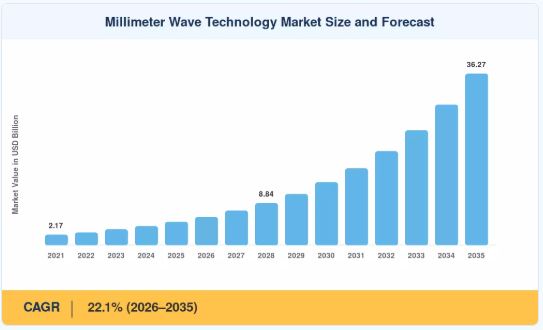
Millimeter Wave Technology Market to Reach USD 36.27 Billion by 2035 at a 22.1% CAGR
Millimeter Wave Technology Market
Millimeter Wave Technology Market Size, Share and Research Report By Component (Antennas and Transceivers, Communications and Networking ICs, Interface
Millimeter Wave Technology Market: Millimeter wave technology is enabling ultra-fast wireless communication for 5G, autonomous vehicles, and next-generation connectivity solutions.”
HONG KONG, HONG KONG, HONG KONG, July 29, 2026 /EINPresswire.com/ -- The Global Millimeter Wave Technology market reached an estimated USD 4.83 billion in 2025 and is projected to grow from roughly USD 6.02 billion in 2026 to USD 36.27 billion by 2035, registering a CAGR of 22.1% during the forecast period. Two converging forces sustain this trajectory: aggressive 5G mid-band and high-band spectrum auctions across 35+ countries, and a parallel push from defense ministries allocating more than USD 6.8 billion annually to next-generation radar procurement a combination of commercial wireless densification and military sensing modernization that has created a dual-track capital expenditure cycle rarely seen in RF component markets. — Market Research Future (MRFR)
The market's 22.1% CAGR reflects the combined pull of 5G network densification and small-cell rollouts (~30% CAGR impact), defense and aerospace radar modernization (~18%), automotive ADAS and V2X integration (~15%), and fixed wireless access expansion (~12%) advancing across telecom, defense, and automotive supply chains simultaneously.
Legacy microwave backhaul links below 15 GHz are increasingly being replaced with mmWave point-to-point systems delivering roughly 10X throughput gains at similar deployment cost. Investment in compound semiconductor production including gallium-nitride-on-silicon-carbide wafer lines integral to high-frequency power amplifiers is reinforcing the domestic supply base, while European defense agencies are co-investing with telecom incumbents to dual-purpose 60 GHz and 77 GHz hardware originally built for civilian broadband into battlefield communication and vehicular radar platforms.
Asia-Pacific dominates the market with an estimated 44.8% share, driven by dense 5G base-station deployment across China and early commercial 28 GHz rollouts in South Korea. North America follows with roughly 28.5% share, supported by FCC spectrum liberalization and CHIPS Act semiconductor financing. Europe trails as the fastest-growing mature economy, with Horizon Europe research funding underpinning sub-terahertz component development. Millimeter wave technology is moving from a niche RF specialization to foundational infrastructure as 5G densification, radar modernization, and early 6G research converge across the decade.
Get Full PDF Sample Copy of Report: (Including Full TOC, List of Tables & Figures, Chart) @
https://www.marketresearchfuture.com/sample_request/3908
➤ How Significant Is the Millimeter Wave Technology Market's Growth?
The millimeter wave technology market's trajectory from USD 4.83 billion in 2025 to a projected USD 36.27 billion by 2035 represents nearly a 7.5-fold expansion over the forecast decade, reflecting the structural shift from sub-6 GHz-only wireless architectures toward high-band spectrum utilization as the baseline for next-generation connectivity, sensing, and imaging. The market's 22.1% CAGR is anchored in a dual commercial-defense investment supercycle where 5G small-cell densification, automotive radar mandates, and defense radar modernization programs are all specifying mmWave hardware as a non-negotiable infrastructure element.
Antennas and Transceivers account for an estimated 34.8% of 2025 revenue, remaining the default choice for phased-array front-end modules in base-station and satellite terminals, while Imaging Sensors are forecast to expand at a 27.1% CAGR through 2035 as security screening and non-invasive medical diagnostics gain traction. The Fully/Partly Licensed segment held an estimated 83.5% share in 2025, underscoring operator preference for interference-managed spectrum, while the 57–95 GHz frequency band captured roughly 49.2% share, spanning both the commercially mature E-band backhaul segment and the high-volume 77 GHz automotive radar band. Telecom Infrastructure represents the largest application segment at approximately 48.9% of demand, followed by Mobile and Consumer Devices at USD 0.74 billion and a fast-growing Automotive ADAS and V2X segment expanding at a 28.3% CAGR.
➤ What Does the Future Hold for the Millimeter Wave Technology Market?
5G network densification and small-cell rollouts contribute approximately 30% to the millimeter wave technology market's CAGR the single highest driver impact. The global small-cell 5G network market is valued at roughly USD 12.4 billion in 2026, reflecting a rapid shift toward high-band spectrum utilization, and with 3GPP standardization encouraging integrated beamforming, this infrastructure expansion remains the primary adoption driver through 2035.
Defense and aerospace radar modernization contributes approximately 18% to the CAGR, establishing NATO-aligned defense procurement as a primary, budget-anchored demand source. The global military radar market, valued at USD 69.6 billion in 2026, is undergoing significant modernization as nations upgrade to high-resolution systems focused on 77 GHz and 94 GHz bands for improved target discrimination, with long-term multi-year contracts for ruggedized RF components and gallium-nitride sensors sustaining this segment.
Automotive ADAS and V2X integration adds a further 15% to the CAGR as the global automotive radar market, projected to reach USD 8.1 billion in 2026, shifts toward 4D imaging radar under stricter international safety mandates, while fixed wireless access expansion with the FWA market valued at roughly USD 86 billion in 2026 and more than 185 million connections established globally contributes an additional 12%.
The next product generation is shifting toward AI-driven beamforming and predictive channel modeling that can improve link reliability by up to 40% in high-mobility environments, reducing the manual engineering overhead of network planning. Vendors are increasingly competing on software ecosystem breadth fleet management dashboards, defect and network analytics, and remote configuration rather than hardware specifications alone, while global R&D initiatives for 6G and sub-terahertz convergence have already secured more than USD 4.5 billion in funding toward 2030 commercialization, positioning today's GaN power amplifier and SiGe beamformer supply chain as the technological foundation for the next generation of deployment.
Get access to the full description of the report @
https://www.marketresearchfuture.com/reports/millimeter-wave-technology-market-3908
➤ Who Are the Key Players in the Millimeter Wave Technology Market?
The millimeter wave technology market is moderately fragmented, with the combined share of the top five players estimated at 42–48% and an approximate Herfindahl-Hirschman Index of 650–800 a structure consistent with a market where large semiconductor and telecom equipment conglomerates coexist with specialized RF component houses. MRFR identifies the following key participants with estimated revenue share ranges:
Qualcomm (~10–13% share) - a vertically integrated modem-RF-antenna leader providing QTM mmWave antenna modules and Snapdragon X-series modems, with the broadest deployed base of smartphone and CPE mmWave designs globally and a patent portfolio spanning beamforming codebook design and antenna calibration.
Samsung Electronics (~9–12% share) - an end-to-end network and device portfolio provider offering 28 GHz massive MIMO radios and 5G mmWave CPEs, leveraging its device and infrastructure businesses to supply carriers across North America, the Middle East, and Latin America.
Nokia Corporation (~7–9% share) - an Open-RAN-ready architecture specialist providing AirScale mmWave radios and E-band microwave backhaul equipment, positioned to serve operators prioritizing interoperable, multi-vendor network deployments.
Ericsson (~6–8% share) - an AI-driven network optimization provider offering the Street Macro and AIR series of mmWave radios, with strength in dense urban small-cell deployments requiring predictive channel management.
Huawei Technologies (~6–9% share) - a scale-economics and patent-depth leader providing 5G AAU and 26 GHz/39 GHz base-station modules, with a manufacturing footprint that continues to shape price-competitive segments of the market.
NEC Corporation (~3–5% share) - a dual-market participant providing 5G mmWave small cells and defense radar systems, leveraging Japan's telecom and defense procurement relationships to anchor regional demand.
Keysight Technologies (~3–4% share) - the de facto standard in mmWave and 6G test infrastructure, providing channel emulators and test platforms that qualify components before they reach commercial deployment.
Siklu Communications (~2–3% share) - a fixed-wireless specialist providing E-band and V-band FWA radios for last-mile broadband delivery in markets underserved by fiber.
Infineon Technologies (~2–4% share) - an automotive Tier-1 supplier partner providing 77 GHz automotive radar transceivers, with the AURIX TC4Dx microcontroller family integrating radar signal processing for L3 autonomous driving applications.
L3Harris Technologies (~2–3% share) - a defense and intelligence-community-focused provider of 94 GHz ISR sensors and electronic-warfare subsystems serving national security procurement programs.
Strategic competition in the millimeter wave technology market is increasingly defined by GaN wafer supply-chain access, spectrum licensing breadth across 24–57 GHz, 57–95 GHz, and 95–300 GHz bands, and the depth of AI-driven beamforming and network-automation software that converts hardware sales into recurring, data-driven service revenue.
➤ What Are the Emerging Trends in the Millimeter Wave Technology Market?
Several transformational trends are redefining the millimeter wave technology market's evolution through 2035:
AI-Driven Beamforming and Network Automation: Machine-learning algorithms are replacing legacy codebook-based beamforming with predictive channel modeling, improving mmWave link reliability by up to 40% in high-mobility environments. Autonomous beam management driven by edge-AI inference is reducing the manual engineering overhead of network planning and accelerating dense coverage expansion.
6G and Sub-Terahertz Convergence: Global R&D initiatives across the U.S., EU, and Asia-Pacific have secured over USD 4.5 billion in funding toward 2030 commercialization. While frequencies exceeding 100 GHz require new waveguide architectures, today's GaN power amplifier and SiGe beamformer supply chain provides the technological foundation for sub-terahertz deployment.
Electrification and Automotive Radar Proliferation: The global electric vehicle fleet is projected to exceed 230 million units by 2030, with each platform increasingly integrating four to six 77 GHz radar sensors for ADAS. As autonomy levels shift toward L3 and L4, rising sensor density is expected to roughly double the addressable market for automotive mmWave components.
Satellite and Non-Terrestrial Network Integration: Low-earth-orbit constellations from operators such as SpaceX, Amazon Kuiper, and OneWeb rely on Ka-band and Q/V-band frequencies that overlap with terrestrial mmWave infrastructure, creating component commonality between satellite gateway antennas and terrestrial small-cell front-ends and reducing per-unit RF module costs by an estimated 12–18%.
Non-Invasive Medical and Security Imaging Expansion: Non-ionizing mmWave imaging in the 60–95 GHz range is gaining traction for dermatology, wound assessment, and airport and border security screening, with active imaging systems at 94 GHz capable of detecting concealed objects at stand-off distances of 5–8 meters.
Network-as-a-Service and Data Monetization: Operators are shifting toward capacity-as-a-service models, selling on-demand, sliced mmWave capacity to enterprise hubs such as stadiums and industrial campuses, transforming infrastructure investments into recurring, high-margin revenue streams that accelerate procurement of advanced mmWave networking equipment.
Buy Full Research Report:
https://www.marketresearchfuture.com/checkout?currency=one_user-USD&report_id=3908
➤ How Is the Millimeter Wave Technology Market Segmented?
The millimeter wave technology market report provides a comprehensive segmentation framework:
By Component: Antennas and Transceivers, Communications and Networking ICs, Interface and Control ICs, Frequency Generation and Filters, Imaging Sensors
By Licensing Model: Fully/Partly Licensed (83.5% share, 2025), Unlicensed (23.7% CAGR)
By Frequency Band: 24–57 GHz, 57–95 GHz (49.2% share, 2025), 95–300 GHz (23.9% CAGR)
By Application: Telecom Infrastructure (48.9% share), Mobile and Consumer Devices, Fixed Wireless Access, Automotive ADAS and V2X (28.3% CAGR), Security and Imaging
By Region: Asia-Pacific (44.8%), North America (28.5%), Europe (17.2%), South America (4.8%), Middle East & Africa (4.7%)
➤ What Are the Regional Insights from the Millimeter Wave Technology Market?
Asia-Pacific leads the millimeter wave technology market with a 44.8% share in 2025, anchored by China's roughly 52% regional share through the world's largest 5G base-station deployment more than 3.8 million installations, a growing share operating in the 26 GHz band. India is the fastest-growing national market within the region at a 25.6% CAGR, driven by the BharatNet Phase III initiative's USD 4.8 billion push toward last-mile connectivity in tier-3 cities. Japan contributes through NTT's IOWN initiative and NEC's radar systems, South Korea through Samsung's global export of mmWave infrastructure, and ASEAN markets are expanding at a 26.3% CAGR as manufacturing relocation from China accelerates across Vietnam, Thailand, and Malaysia.
North America holds approximately 28.5% of global revenue, with the United States commanding roughly 82% of regional revenue through FCC spectrum liberalization including the release of 14 GHz of contiguous bandwidth above 24 GHz and Department of Defense allocations of USD 3.1 billion toward next-generation electronic warfare systems. Canada is growing at a 22.8% CAGR through rural broadband mandates and Arctic defense initiatives, while Mexico's participation remains nascent but growing as IFT spectrum plans target 26 GHz auctions by 2027.
Europe accounts for 17.2% of global market share, with Germany commanding around 26% of regional revenue through its concentration of automotive OEMs Bosch, Continental, and ZF driving 77 GHz radar design wins exceeding 35 million units annually. The UK is growing at a 21.4% CAGR as Ofcom earmarks 40 GHz spectrum for shared access, France leverages its defense-electronics base through Thales and Safran, and the EU's Horizon Europe framework has committed EUR 1.2 billion to 6G and sub-terahertz research through 2027.
South America and the Middle East & Africa each represent a smaller but structurally growing share of global revenue. Brazil commands approximately 58% of South American revenue following Anatel's initial 26 GHz licensing that enabled Vivo and Claro to pilot mmWave fixed wireless in São Paulo and Rio de Janeiro, with Argentina's telecom infrastructure renewal adding a 21.2% CAGR. In the Middle East & Africa, Saudi Arabia holds roughly 34% of regional revenue through the NEOM smart-city project's dedicated 28 GHz mmWave mesh network, the UAE is expanding at a 23.4% CAGR through Etisalat and du's E-band backhaul allocations, and South Africa and Egypt are building out FWA and administrative-capital connectivity programs that represent the region's next wave of adoption through 2035.
➤➤➤ Industry Analysis Reports by Market Research Future:
Surface Mount Reed Relay Market
https://www.marketresearchfuture.com/reports/surface-mount-reed-relay-market-37651
Video Conferencing Hardware Market
https://www.marketresearchfuture.com/reports/video-conferencing-hardware-market-37705
Robotics Prototyping Market
https://www.marketresearchfuture.com/reports/robotics-prototyping-market-37812
Liquid Analyzer Service Market
https://www.marketresearchfuture.com/reports/liquid-analyzer-service-market-37883
Semiconductor Diode Market
https://www.marketresearchfuture.com/reports/semiconductor-diode-market-37884
Smart Industries Market
https://www.marketresearchfuture.com/reports/smart-industries-market-37895
Semiconductor Advanced Substrate Market
https://www.marketresearchfuture.com/reports/semiconductor-advanced-substrate-market-38066
Usb Flash Drives Market
https://www.marketresearchfuture.com/reports/usb-flash-drives-market-38381
Gan Power Ics Market
https://www.marketresearchfuture.com/reports/gan-power-ics-market-38498
Flash Charger Adapter Market
https://www.marketresearchfuture.com/reports/flash-charger-adapter-market-38508
Sagar Kadam
Market Research Future
+ + +1 628-258-0071
email us here
Legal Disclaimer:
EIN Presswire provides this news content "as is" without warranty of any kind. We do not accept any responsibility or liability for the accuracy, content, images, videos, licenses, completeness, legality, or reliability of the information contained in this article. If you have any complaints or copyright issues related to this article, kindly contact the author above.
