

Cloud Sustainability Market Set for Remarkable Growth to Reach USD 247.27 billion by 2034 | CAGR 23.7% (2026-2034)
Cloud Sustainability Market Size 2026
North America dominated the cloud sustainability market with a market share of 33.90% in 2025.
Growing Adoption of Carbon-Aware Cloud Management and Real-Time Emissions Monitoring Fuels New Market Trends”
NY, UNITED STATES, February 11, 2026 /EINPresswire.com/ -- The cloud sustainability market size 2026 represents one of the fastest-growing segments in environmental technology, reflecting the increasing corporate commitment to decarbonization and responsible digital infrastructure. According to Fortune Business Insights, the global market value stood at USD 36.69 billion in 2025 and is projected to reach USD 247.27 billion by 2034, demonstrating remarkable expansion potential.— Fortune Business Insights
The market encompasses comprehensive solutions including carbon footprint management, sustainable cloud optimization, and green cloud infrastructure delivered across public, private, and hybrid environments. These technologies enable enterprises to measure, manage, and minimize cloud-related energy consumption and emissions systematically.
Get a Free Sample PDF: https://www.fortunebusinessinsights.com/enquiry/request-sample-pdf/cloud-sustainability-market-114657
Market Performance and Growth Trajectory
The market is expected to exhibit a CAGR of 23.7% during the forecast period of 2026-2034, driven by multiple converging factors. This impressive growth rate underscores the urgency with which organizations are approaching environmental responsibility in their digital operations.
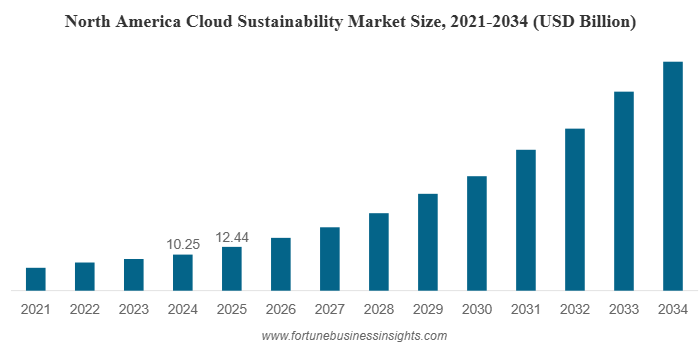
North America currently dominates the landscape, with the market value stood at USD 12.44 billion in 2025, representing approximately 33.90% of global market share. This regional leadership stems from high cloud adoption rates, presence of hyperscale data centers, and concentration of leading technology providers.
Key Market Drivers
The primary catalyst accelerating adoption is enterprise commitment to net-zero and ESG objectives. According to the NewClimate Institute's Net Zero Stocktake 2025, 63% of publicly listed companies globally have set net-zero targets, representing approximately USD 36.6 trillion in annual revenue. Organizations across sectors are prioritizing carbon neutrality, prompting greater investments in emissions measurement and optimization tools.
Another significant driver involves the integration of carbon-aware workload management and real-time emissions monitoring within cloud platforms. By 2026, 50% of organizations will adopt sustainability-enabled monitoring to reduce energy consumption and carbon footprint metrics for their hybrid cloud. Cloud providers and enterprises are embedding dashboards and analytics that quantify energy consumption and associated carbon output at the workload, application, and business-unit level.
Market Segmentation Insights
Green cloud infrastructure leads the solution segment as organizations prioritize sustainable data centers, renewable-powered facilities, and optimized hardware as foundational steps to reducing environmental impact. Major cloud providers have made substantial capital investments in green infrastructure, generating large recurring revenue streams from existing enterprise workloads.
However, carbon footprint management is expected to grow at the maximum rate of 25.3% as enterprises increasingly seek granular visibility into emissions to meet regulatory disclosure and ESG reporting requirements. The growing need for automated tracking, benchmarking, and audit-ready sustainability data drives accelerated adoption of advanced carbon accounting platforms.
Public cloud deployment dominates market growth due to hyperscale providers offering mature, globally distributed, and energy-optimized infrastructure that enables rapid, low-cost access to sustainable computing resources. Meanwhile, hybrid cloud is projected to grow at the highest rate of 25.2% as organizations adopt mixed environments to balance regulatory, data residency, and latency needs while leveraging green public cloud capabilities.
Industry Applications
The IT and telecom sector holds the highest market share because it operates large-scale data centers and network infrastructure, making it both a major consumer of cloud resources and an early adopter of efficiency initiatives. Service providers increasingly embed sustainability as a differentiator in their cloud offerings.
Manufacturing is expected to post the highest growth rate of 27.2% as smart factories, IoT, and digital twin adoption increase reliance on energy-efficient cloud infrastructure. Rising pressure to decarbonize operations and supply chains further accelerates sustainable cloud adoption in this sector.
Regional Market Dynamics
North America maintains market leadership owing to high cloud adoption rates, presence of hyperscale data centers, and strong concentration of leading providers. Enterprises in the region are early adopters of ESG frameworks and net-zero commitments, driving substantial investment in green cloud infrastructure and carbon management tools.
Europe holds the second-largest market share due to stringent environmental regulations, including EU-wide climate targets and disclosure requirements that compel organizations to decarbonize IT operations. The region's strong policy focus on energy efficiency and renewable integration supports steady demand for sustainability solutions.
Asia Pacific is expected to grow at the highest rate, driven by rapid cloud adoption, accelerating digital transformation, and large-scale data center expansion across China, India, Japan, and Southeast Asia. Governments and enterprises increasingly prioritize energy efficiency and emissions reduction as power demand from digital infrastructure continues rising.
Speak To Analyst- https://www.fortunebusinessinsights.com/enquiry/speak-to-analyst/cloud-sustainability-market-114657
The market features several dominant players including Amazon Web Services, Microsoft Corporation, and Google LLC. These companies leverage technological advancements to enhance market positioning by addressing diverse consumer needs and staying ahead of competitors.
Recent strategic developments highlight industry momentum. In November 2025, Fujitsu, in collaboration with AWS Japan, established a business creation lab to advance joint innovation under their global strategic collaboration agreement. The lab combines Fujitsu's industry expertise with AWS's generative AI and cloud capabilities to help Japanese retail and service-sector customers modernize legacy systems.
In June 2025, Salesforce launched Agentforce for Net Zero Cloud, a unified data-driven platform intended to support teams in meeting sustainability compliance requirements. The solution enables organizations to reduce environmental impacts by providing integrated sustainability insights.
In May 2025, Microsoft introduced a suite of new solutions and capabilities designed to help Azure users incorporate sustainability considerations into their cloud migration strategies. These enhancements enable organizations to more effectively manage and reduce the carbon footprint associated with their cloud usage.
Market Challenges and Opportunities
A key restraint involves high implementation complexity and limited standardization. Many organizations struggle with inconsistent data sources, fragmented systems, and differing methodologies for calculating cloud-related emissions. The lack of globally accepted standards for cloud carbon accounting creates uncertainty and slows adoption.
However, significant opportunities exist in expanding tailored solutions for small and medium-sized enterprises. According to The Institute of Chartered Accountants in England and Wales, only 8% of SMEs currently report on sustainability issues, indicating a large underserved market for tailored sustainability solutions. Vendors can capitalize on this gap by offering simplified, cost-effective, and pre-configured cloud sustainability packages.
Ashwin Arora
Fortune Business Insights™ Pvt. Ltd.
+1 833-909-2966
sales@fortunebusinessinsights.com
Legal Disclaimer:
EIN Presswire provides this news content "as is" without warranty of any kind. We do not accept any responsibility or liability for the accuracy, content, images, videos, licenses, completeness, legality, or reliability of the information contained in this article. If you have any complaints or copyright issues related to this article, kindly contact the author above.
