

Global Waterless Cleansing Balms Market to Reach USD 669.7 million by 2036 with 6.2% CAGR, Driven by Sustainability
Waterless Cleansing Balms Market
Rising demand for eco-friendly, high-performance waterless cleansing balms reshapes skincare industry through 2036.
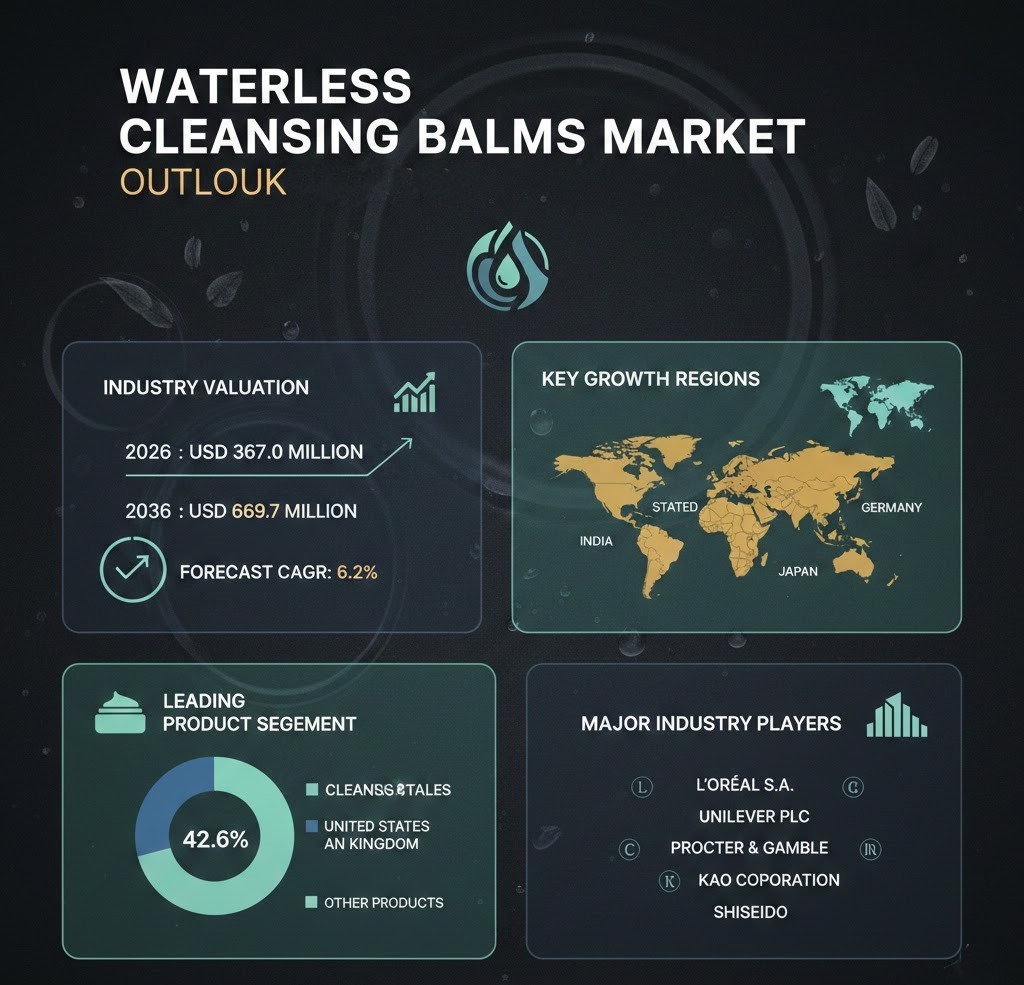
NEWARK, DE, UNITED STATES, February 3, 2026 /EINPresswire.com/ -- The global waterless cleansing balms market is poised for significant growth, projected to expand from USD 367.0 million in 2026 to USD 669.7 million by 2036, reflecting a compound annual growth rate (CAGR) of 6.2%, according to the latest market research by Future Market Insights (FMI). This expansion marks a fundamental shift in consumer preference and industry strategy, as waterless cleansing balms move beyond niche appeal to become an essential element in modern skincare routines worldwide.
Request For Sample Report | Customize Report |purchase Full Report – https://www.futuremarketinsights.com/reports/sample/rep-gb-31778
Rising Demand for Waterless Cleansing Balms Driven by Sustainability and Performance
Waterless cleansing balms, typically formulated without added water, are increasingly favored for their gentle yet effective makeup removal capabilities and skin barrier protection, particularly in environments where water access is limited or for consumers prioritizing travel-friendly skincare solutions. The trend reflects a broader industry pivot towards ingredient transparency, sensorial familiarity, and sustainability.
“As we transform our company to better capture growth and drive profitability, we remain steadfast in our commitment to advancing environmental stewardship and social impact,” said Stéphane de La Faverie, President & CEO of The Estée Lauder Companies, underscoring the strategic importance of waterless innovation.
Major beauty corporations such as Estée Lauder, L’Oréal, Unilever, and Shiseido are operationalizing environmental goals into their product pipelines by scaling balm-based formulations that combine efficacy, preservation efficiency, and luxury positioning without reliance on water as a carrier. This innovation coincides with growing regulatory pressures and evolving consumer expectations, propelling the market from experimental to mainstream status.
Market Dynamics and Key Drivers
Historically, waterless cleansing balms were perceived as niche products, often critiqued for their texture and rinsing difficulties. However, advancements in formulation technology have enabled the creation of high-active concentration balms that address these concerns while offering multi-functional skincare benefits. For instance, Dove’s Serum Bar and P&G’s Gemz represent next-generation balms that deliver concentrated actives and conditioning benefits, repositioning the category within layered skincare regimens.
Logistical advantages also bolster market growth. By eliminating water—which constitutes 70-90% of traditional liquid cleansers—waterless balms reduce product weight by up to 60%, improving shipping efficiency and lowering carbon footprints. Regulatory frameworks such as the Extended Producer Responsibility (EPR) in the UK and EU incentivize low-packaging, waterless formats due to reduced tax liabilities and simpler compliance, accelerating adoption across retail channels.
Market Segmentation and Regional Insights
The waterless cleansing balms market encompasses diverse product types, including cleansing balms, foaming tablets, solid concentrates, cleansing oils, and powder bars. Cleansing balms dominate with a 42.6% market share, driven by their efficacy and convenience.
Formulation trends show a significant shift toward natural and botanical ingredients, which account for 38.4% of market formulations. Brands such as Beiersdorf and Croda emphasize plant-based surfactants and renewable raw materials, aligning product safety with sustainability imperatives.
Regionally, the market is led by India, the United States, the United Kingdom, Germany, and Japan, with forecasted CAGRs of 7.6%, 6.9%, 6.3%, 6.1%, and 6.0%, respectively.
• India’s growth is influenced by stringent Plastic Waste Management rules, driving demand for biodegradable packaging and solid-to-balm products. Local brands like Earth Rhythm spearhead this movement with compostable, plastic-free formulations.
• The UK market responds strategically to the Plastic Packaging Tax and EPR, with companies like Unilever pivoting towards anhydrous formulations to reduce tax exposure and packaging waste.
• Germany's market thrives on high consumer standards for certified safety and environmental performance, with waterless products gaining acceptance in mainstream drugstores through independent validation.
• The US market benefits from institutional trust, with the Environmental Working Group (EWG) Verified® seal playing a pivotal role in consumer confidence and retail positioning.
• Japan’s market aligns closely with its Resource Circulation Law, emphasizing circular economy principles and fostering adoption through industry commitments to plastic waste reduction.
Leading Market Players and Competitive Landscape
Industry leaders driving the global expansion of waterless cleansing balms include:
• L’Oréal S.A.
• Unilever Plc
• Procter & Gamble
• Kao Corporation
• Shiseido
• Estée Lauder Companies Inc.
• Beiersdorf AG
• Henkel
• Coty
• Revlon
• Johnson & Johnson
• Avon
• Oriflame
• Earth Rhythm
• SBTRCT
These companies leverage innovation in formulation, sustainable packaging, and retail normalization to integrate waterless balms into everyday skincare, balancing performance demands with environmental commitments.
Challenges and Market Constraints
Despite positive momentum, the market faces challenges including:
• Thermal sensitivity of oil-and-wax blends, which may cause formulation instability during transport.
• Higher upfront price points compared to liquid cleansers due to concentrated active ingredients.
• Consumer hesitation in mass-market segments regarding cost-per-use value propositions.
Overcoming these constraints will require continued innovation in supply chain resilience, price accessibility, and consumer education on long-term benefits.
Future Outlook
The waterless cleansing balms market is transitioning from a novelty to an indispensable category driven by performance parity with liquid cleansers, regulatory support, and retail mainstreaming. With sustainability and consumer health at the forefront, waterless balms are expected to maintain robust growth through 2036, supported by advances in natural formulation, packaging reduction, and multi-functional skincare technologies.
Browse Related Insights
Waterless Cosmetics Market : https://www.futuremarketinsights.com/reports/waterless-cosmetic-market
Waterless Cosmetics Powders Market : https://www.futuremarketinsights.com/reports/waterless-cosmetics-powders-market
Bath Salts Market: https://www.futuremarketinsights.com/reports/bath-salts-market
About Future Market Insights (FMI)
Future Market Insights, Inc. (FMI) is an ESOMAR-certified, ISO 9001:2015 market research and consulting organization, trusted by Fortune 500 clients and global enterprises. With operations in the U.S., UK, India, and Dubai, FMI provides data-backed insights and strategic intelligence across 30+ industries and 1200 markets worldwide.
Sudip Saha
Future Market Insights Inc.
+1 347-918-3531
email us here
Legal Disclaimer:
EIN Presswire provides this news content "as is" without warranty of any kind. We do not accept any responsibility or liability for the accuracy, content, images, videos, licenses, completeness, legality, or reliability of the information contained in this article. If you have any complaints or copyright issues related to this article, kindly contact the author above.
